
Transfer Benches for Seniors: The Complete Guide
14 min read
Quick Answer: A transfer bench is a wide bench that straddles the edge of a bathtub, allowing a senior to sit down outside the tub and slide across the wall into bathing position — without stepping over the edge. Transfer benches for seniors range from standard models ($50–$70) to sliding benches ($90–$200) for users with limited upper-body strength. For most seniors, the Drive Medical Tub Transfer Bench (model 12011kd-1, ASIN B002VWK0T6) is the best starting point — limited lifetime warranty, 32,000+ verified reviews, under $55.
Getting in and out of a bathtub is one of the most dangerous moments in a senior’s day. It requires stepping over a raised wall, balancing on one leg, often on a wet surface — a combination that puts even physically capable older adults at serious risk. According to the CDC, bathrooms are among the most common sites for fall-related injuries in older adults, and the bathtub entry and exit moment is when those injuries most often happen.
A transfer bench eliminates that moment entirely. It is one of the simplest, most affordable, and most effective home safety products available for seniors — and it requires no installation, no renovation, and no contractor. This guide covers everything a caregiver or family member needs to know: what transfer benches are, who needs one, how to choose the right type, how to use one safely, and which specific products we recommend after analyzing over 62,000 buyer reviews.
As an Amazon Associate, BestSeniorReviews.com earns from qualifying purchases. This page may also contain affiliate links to other trusted retailers, at no extra cost to you.
What Is a Transfer Bench — and How Does It Work?
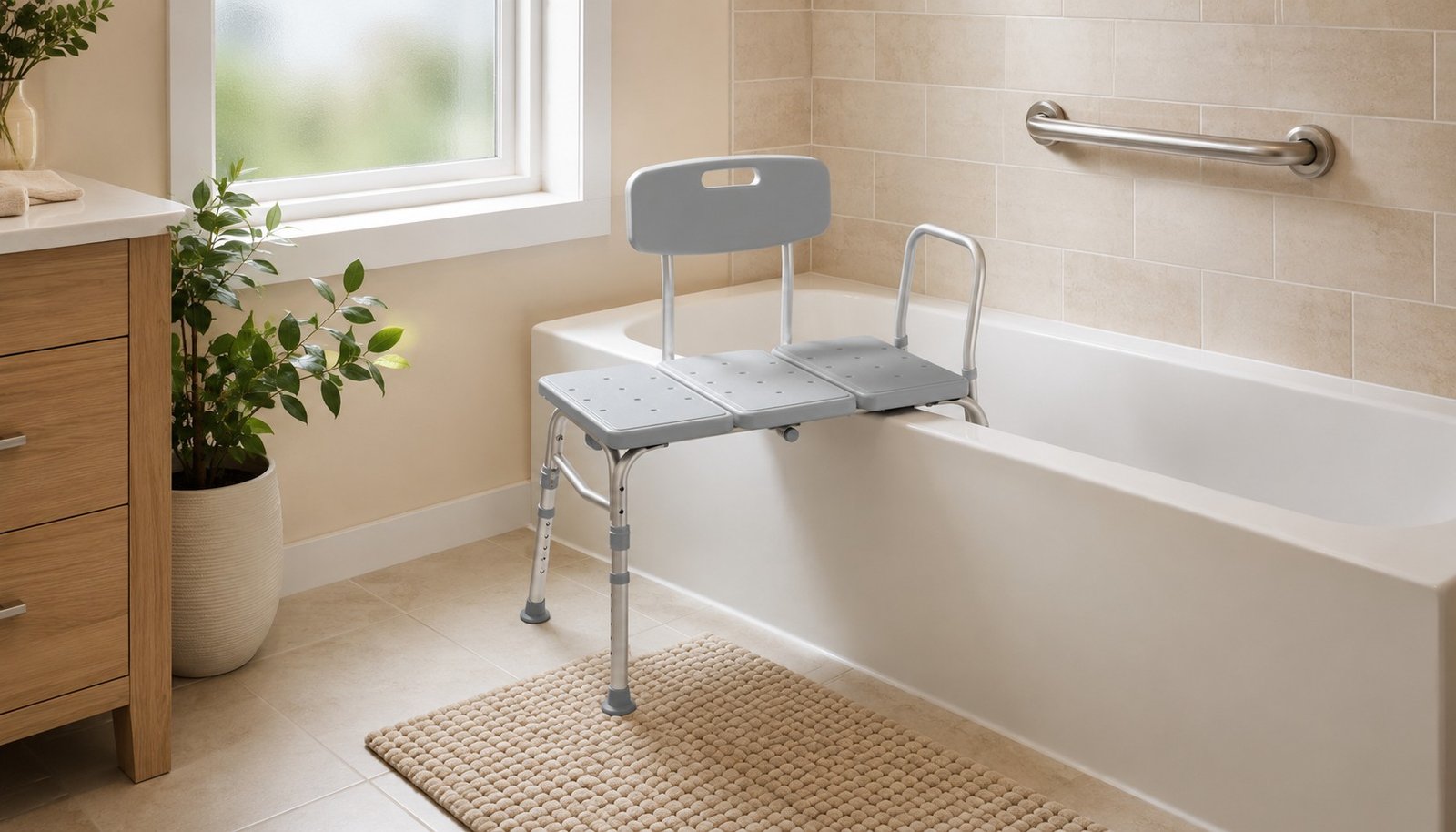
A transfer bench is a wide, sturdy bench designed to straddle the wall of a standard bathtub. It has four adjustable legs — two that sit on the bathroom floor outside the tub, and two that rest on the tub floor inside. The seat spans across the top of the tub wall, creating a bridge the user can sit on and slide across.
The transfer process works like this: the user sits down on the outside portion of the bench — feet still on the bathroom floor, no stepping involved. They then slide themselves sideways across the seat, over the tub wall, until they are seated over the tub. They lift their legs in one at a time, keeping one hand on the armrest for support. To exit, the process reverses. At no point does the user need to step over the tub wall or balance on one leg.
This is a meaningfully different product from a shower chair, a bath lift, or a grab bar — and the distinction matters when choosing the right solution:
| Product | How it works | Best for | Requires tub entry? |
|---|---|---|---|
| Transfer bench | Straddles tub wall — user slides across seated | Seniors who cannot safely step over the tub edge | No — seated slide only |
| Shower chair | Sits entirely inside shower or tub | Seniors who can get in safely but need to sit while bathing | Yes — must step in first |
| Bath lift | Motorized or mechanical — lowers user into tub water | Seniors who want a full tub soak and cannot lower themselves | Yes — lowers into water |
| Grab bar | Wall-mounted support for balance during entry/exit | Seniors who can still step over but need stability support | Yes — must step over |
Who Needs a Transfer Bench?
A transfer bench is appropriate when the risk of stepping over the tub wall has become genuinely dangerous — not just inconvenient. The National Council on Aging identifies bathtub entry and exit as a high-risk activity for older adults, particularly those with any of the following conditions or situations:
Post-surgery recovery — especially hip or knee replacement: After joint replacement surgery, stepping over a tub wall places exactly the kind of stress on the new joint that surgeons advise against. A transfer bench allows a senior to resume independent bathing during recovery without violating movement restrictions.
Balance decline or dizziness: Any condition that affects balance — inner ear issues, medication side effects, neurological changes — makes the single-leg balance required to step over a tub wall disproportionately risky. A seated transfer eliminates the balance demand entirely.
Arthritis or limited hip flexibility: Lifting a leg high enough to clear a tub wall requires significant hip flexion. For seniors with hip arthritis or reduced range of motion, this movement may be painful, unreliable, or impossible. A transfer bench removes the need for it.
Stroke recovery or one-sided weakness: Seniors recovering from a stroke often have reduced strength or control on one side of the body. A transfer bench with a properly configured armrest on the stronger side allows them to support themselves during the transfer without depending on the weaker side.
General frailty or reduced lower-body strength: Even without a specific diagnosis, the natural strength decline that comes with aging can make the bathtub step-over feel unsafe. A transfer bench is appropriate any time a senior — or their family — feels that the tub entry has become a moment of genuine risk.
Caregiver-assisted bathing: When a caregiver assists with bathing, a transfer bench makes the process safer for both the senior and the caregiver — reducing the physical demand of supporting a person during a step-over transfer.
Standard vs. Sliding Transfer Benches — The Key Decision
The single most important choice in selecting a transfer bench is the bench type. Every other decision — weight capacity, width, warranty — comes after this one.
| Standard Bench | Sliding Bench | |
|---|---|---|
| How the transfer works | User pushes or slides themselves across the fixed seat using their arms | Seat moves on a track — user sits and the seat slides across for them |
| Upper-body strength required | Moderate — enough to push off and slide sideways | Minimal — seat does the lateral movement |
| Price range | $50–$70 | $90–$200 |
| Overall width | 28″–35″ | 34″–39″ |
| Best for | Most seniors with reasonable arm and shoulder strength | Seniors with significantly limited upper-body strength or shoulder conditions |
| Products in our set | Drive Medical 12011kd-1, Medline MDS86960KDMBH, Carex FGB15300, Medline G3-100KBX1 | DMI 522-1734-1900, Platinum Health PHB3400, KingPavonini MYY-Slide |
If you are unsure which type is appropriate, a physical therapist or occupational therapist can assess upper-body strength and recommend the right fit. Many home health agencies offer a single-session assessment specifically for this kind of adaptive equipment decision.
The 5 Things That Matter Most When Choosing
1. Weight capacity — always build in a 50 lb margin
Transfer benches in our evaluated set range from 300 lbs (Carex FGB15300) to 550 lbs (KingPavonini MYY-Slide). The correct approach is to choose a bench rated at least 50 lbs above the user’s current weight. Sitting down and shifting position during a transfer generates momentary force greater than static body weight — buying at the exact limit provides no safety margin for that dynamic load. If your parent weighs 340 lbs, the minimum safe choice is a 400 lb bench.
2. Overall width — measure your bathroom before ordering
Transfer benches range from 28″ to 39″ in total width. In bathrooms where the toilet sits close to the tub, a bench that is too wide will crowd the floor space, block toilet access, or force an approach angle that creates new fall risk. Measure the clear floor space between the tub wall and the nearest obstruction before ordering. Compare that measurement to the bench’s overall width — not the seat width, which is narrower.
3. Leg height range — does it match your parent’s height?
All benches in our evaluated set are height-adjustable, but the ranges differ significantly. The lowest minimum height is 14″ (Platinum Health PHB3400 and KingPavonini MYY-Slide); the highest minimum is 19.5″ (Medline MDS86960KDMBH). When seated correctly, feet should rest flat on the floor with knees at approximately 90°. For shorter seniors — roughly under 5′2″ — a bench with a lower minimum height is not optional, it is a safety requirement.
4. Reversible setup — confirm left vs. right before assembling
All seven benches in our evaluated set are reversible for left or right tub entry. Before assembling, stand at the tub and identify which side your parent approaches from — typically toward the toilet or the bathroom door. The open side of the bench (no tub wall) should face that direction. Getting this wrong does not ruin the bench — all are reconfigurable — but getting it right on the first setup saves a frustrating disassembly.
5. Hygiene cutout — often overlooked, frequently needed
If a caregiver assists with perineal hygiene during bathing, a bench with a hygiene cutout (sometimes called a commode opening) in the seat makes that process significantly more manageable. Of the seven benches in our evaluated set, only the DMI 522-1734-1900 includes one. It is worth paying the difference over a standard bench if caregiver-assisted hygiene is part of the care routine.
What Transfer Benches Cannot Do
Being clear about the limits of a product is as important as explaining what it does well. A transfer bench is not the right solution in every situation:
A transfer bench is not a substitute for a bath lift if your parent wants to soak in a full tub of water. A transfer bench positions the user above the tub floor for a shower-style wash — it does not lower them into standing water. For seniors who want a genuine tub soak and cannot lower themselves safely, a bath lift is the appropriate product.
A transfer bench does not work with a walk-in shower. It is designed specifically for bathtubs with a wall to straddle. For walk-in showers, a shower chair or fold-down shower seat is the correct product.
A transfer bench is not appropriate for users who cannot bear any weight on their legs. The transfer process requires the user to stand briefly or support some weight through their legs when moving their feet over the tub wall. For users who are fully non-weight-bearing, a patient lift or full caregiver transfer is needed instead.
A transfer bench does not replace grab bars. Grab bars and transfer benches serve complementary roles — a grab bar mounted at the correct height near the bench gives the user a fixed support point during the transfer that the bench armrest alone cannot fully provide. The Mayo Clinic recommends a layered approach to bathroom fall prevention that typically includes both types of equipment.
Our Recommended Transfer Benches
These are the four products from our full evaluation that cover the widest range of needs:
Best overall — Drive Medical Tub Transfer Bench (12011kd-1, ASIN B002VWK0T6): The top pick for most seniors. Limited lifetime warranty, 32,000+ verified reviews, reversible setup, tool-free assembly, under $55. The most proven transfer bench available at any price. Check price on Amazon →
Best for antimicrobial protection — Medline MDS86960KDMBH (ASIN B00AIMT4CA): Microban antimicrobial protection built into the plastic — not a coating. Limited lifetime warranty. Narrowest footprint in our set at 28″, making it the best standard bench for tighter bathrooms. Check price on Amazon →
Best sliding bench with hygiene cutout — DMI 522-1734-1900 (ASIN B000NGUD94): The only sliding bench in our set with a hygiene cutout. Also includes a seatbelt, shower wand holder, and 400 lb capacity. FSA/HSA eligible. Around $90. Check price on Amazon →
Best premium sliding bench — Platinum Health Carousel PHB3400 (ASIN B0184P0UZ2): The only fully padded bench in our set — medical-grade closed-cell polyurethane on the seat, backrest, and armrests. Swivel and sliding seat with pivoting arms. Around $200. Check price on Amazon →
Go Deeper — Our Full Transfer Bench Resources
This guide gives you the full picture. For specific product comparisons, detailed specs, and buying decisions, these three articles go further:
- Best Transfer Benches for Seniors (2026) — our full roundup reviewing all 7 products with detailed specs, pros, cons, and buyer analysis across 62,000+ reviews.
- How to Choose a Transfer Bench for Seniors — a plain-language buying guide covering every decision point before you purchase.
- Drive Medical Tub Transfer Bench Review (Model 12011kd-1) — our complete deep-dive on the top pick, including a full spec table, customer feedback analysis, and honest limitations.
Transfer Bench Safety Tips
Buying the right bench is step one. Using it correctly is what actually prevents falls. These six tips apply regardless of which bench you choose:
Set the leg height before the first use — and check it again after
Leg height should be set so the user’s feet rest flat on the floor when seated on the outside portion of the bench, with knees at roughly 90°. This is not a one-time setup — check it periodically, particularly if a different caregiver assembled or moved the bench. A bench set too high creates a dangerous drop when the user lowers themselves; too low creates excessive forward lean.
Level the bench if your tub floor is uneven
Many older bathtubs have a slightly curved or uneven interior floor. If the two inside legs sit at different heights, the bench will tilt toward the tub — exactly the wrong direction during a transfer. Rubber leg extenders (available separately) can level the bench without damaging the tub surface. Test stability by pressing down on each corner before use.
Check the non-slip feet before every use
The rubber non-slip feet on all four legs are the bench’s primary anti-slip mechanism on a wet surface. Inspect them periodically for wear, cracking, or compression. A worn rubber foot on a wet tub floor provides significantly less grip than a new one. Replacement feet are inexpensive and available from most manufacturers.
Keep the transfer path clear
The floor space on the outside of the bench — where the user sits down and lifts their feet — should be clear of bath mats, towels, and any objects that could catch a foot during transfer. A single non-slip bath mat positioned slightly away from the bench is appropriate; a bunched or overlapping mat is a trip hazard.
Confirm the bench is stable before every transfer
Before sitting down, press down on the outside edge of the bench seat with one hand. It should feel completely solid with no wobble, rocking, or shift. If it moves, stop and check the leg positions before proceeding. A bench that shifts during a transfer is more dangerous than no bench at all.
Replace the bench if the frame shows corrosion or cracking
Aluminum frames resist rust well, but the plastic components — particularly the leg adjustment buttons and seat surface — can degrade over time in a wet environment. Any cracking in the seat, failure of a leg adjustment button to lock securely, or visible corrosion on the frame are signals to replace the bench. For a product a senior depends on daily for safety, the replacement cost is never a reason to continue using a compromised bench.
Frequently Asked Questions
What is the difference between a transfer bench and a shower chair?
A shower chair sits entirely inside a shower or bathtub and is designed for users who can already get in safely — they just need to sit while bathing. A transfer bench straddles the tub wall, with two legs inside and two legs outside, and allows the user to slide across the wall seated rather than stepping over it. If your parent cannot safely step over the tub edge, a transfer bench is the appropriate product. If they can get in safely but need to sit while bathing, a shower chair is sufficient.
Does Medicare cover transfer benches?
Transfer benches may qualify as durable medical equipment (DME) under Medicare Part B if prescribed by a physician and deemed medically necessary for the patient’s condition. Coverage is not automatic — it depends on the specific diagnosis, the physician’s documentation, and whether the supplier is Medicare-approved. Several benches in our evaluated set are also FSA and HSA eligible regardless of Medicare status, which allows buyers with flexible spending accounts to use pre-tax dollars toward the purchase. Confirm coverage with your parent’s physician and insurance provider before purchasing.
How long does a transfer bench last?
With daily use in a wet environment, a well-maintained aluminum-frame transfer bench typically lasts several years. The Drive Medical 12011kd-1 carries a limited lifetime warranty — the strongest coverage in our evaluated set — which reflects confidence in long-term durability. The components most likely to need attention over time are the rubber non-slip feet (replaceable) and the plastic leg adjustment buttons. Replace the bench if any structural component fails or if the seat surface shows cracking.
Can a transfer bench be used with a walk-in tub?
No — transfer benches are designed for standard bathtubs with a raised wall to straddle. Walk-in tubs have a door in the side wall and a lower threshold specifically to eliminate the step-over problem. Using a transfer bench with a walk-in tub is not appropriate and would not function as intended. If your parent has a walk-in tub, the tub itself is the accessibility solution — no transfer bench is needed.
Can a caregiver use a transfer bench alone with a senior?
Yes — transfer benches are designed to be used with one caregiver assisting. The standard approach is for the caregiver to stand on the outside of the tub, guide the senior’s slide across the bench, and assist with lifting each leg over the wall. For seniors who need hygiene assistance during bathing, the DMI 522-1734-1900 with its hygiene cutout makes caregiver-assisted care significantly more manageable than a standard bench.
What is the best transfer bench for a bariatric user?
For users over 400 lbs who also need a sliding bench, the KingPavonini MYY-Slide (ASIN B0F6N6NR3J) is the only option in our evaluated set — rated to 550 lbs with a sliding and swivel seat, bilateral armrests, and a seatbelt. For users over 350 lbs who can use a standard bench, the Medline G3-100KBX1 (ASIN B086TPM48Y) offers 400 lb capacity at around $70. Always choose a bench rated at least 50 lbs above the user’s actual weight.
Do transfer benches damage the bathtub?
Transfer benches rest on rubber non-slip feet and require no drilling, adhesive, or permanent attachment. They should not damage a standard acrylic or porcelain tub when used correctly. In older cast-iron tubs with curved interior floors, rubber leg extenders can prevent the inside legs from scratching the surface while leveling the bench. Do not use a bench that requires forcing the legs into position — if the fit feels wrong, recheck the leg heights and tub floor levelness before proceeding.
Is a transfer bench the same as a bath transfer board?
No — these are different products. A bath transfer board is a flat board used to help a person slide from a wheelchair to another surface; it is not designed for tub use. A transfer bench is a freestanding bench specifically engineered to straddle a bathtub wall and support a seated transfer into and out of the tub. The two products serve different transfer scenarios and should not be confused when purchasing.
Last reviewed: June 2026


