How to Choose a Transfer Bench for Seniors: A Plain-Language Guide

8 min read
Quick Answer: To choose the right transfer bench, first decide between a standard bench (user slides themselves) and a sliding bench (seat moves on a track — better for very limited upper-body strength). Then confirm the weight capacity exceeds the user’s weight by at least 50 lbs, and measure your bathroom’s floor width before ordering. For most seniors, a standard bench in the $50–$70 range covers every need. A sliding bench makes sense when arm or shoulder strength is significantly limited.
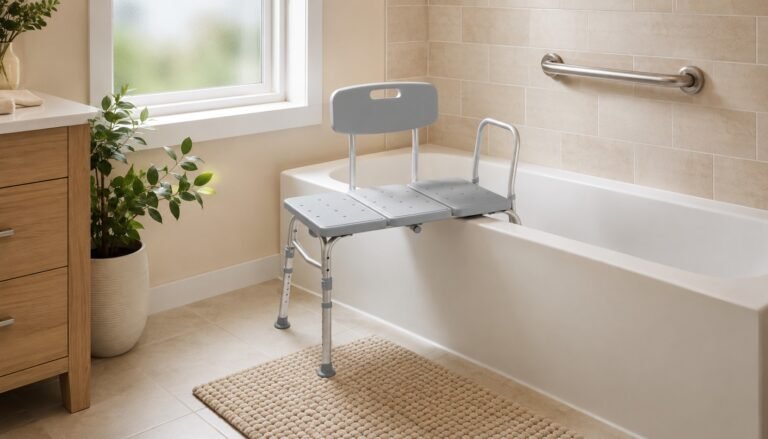
Bathing is one of the highest-risk daily activities for seniors. The moment of stepping over a tub wall — balancing on one leg, often on a wet surface — is exactly the kind of movement that leads to falls. A transfer bench eliminates that moment entirely. Instead of stepping over the tub edge, your parent sits down on the bench outside the tub and slides across into position.
It is a simple, low-cost solution that does not require any renovation — most benches set up tool-free in under 15 minutes. But with several different types, weight limits, and widths available, choosing the wrong bench can create new problems instead of solving old ones. This guide covers everything you need to know before buying.
As an Amazon Associate, BestSeniorReviews.com earns from qualifying purchases. This page may also contain affiliate links to other trusted retailers, at no extra cost to you.
If you are ready to skip straight to specific product recommendations, see our full roundup: Best Transfer Benches for Seniors: 7 Safe, Sturdy Picks →
Do seniors actually need a different kind of bath bench?
Not a different category — but different priorities. A standard shower stool is designed for someone who can already get into the shower safely on their own; they just want to sit while bathing. A transfer bench is designed for someone who cannot safely step over a tub wall at all. The bench straddles the tub edge — two legs inside, two outside — and the user never has to stand and lift a leg over anything. That distinction matters enormously when mobility or balance is compromised. According to the CDC, the bathroom is one of the most common sites for fall-related injuries among older adults — and the transfer moment is when most of those injuries happen.
Key Factors to Consider When Choosing a Transfer Bench
1. Standard vs. sliding — the most important decision you will make
A standard transfer bench has a fixed seat. The user sits on the outside portion and uses their arms to push or slide their body across the tub wall into position over the tub. This works well for seniors who retain reasonable upper-body strength and some core stability.
A sliding transfer bench has a seat that moves on a track built into the bench frame. The user sits down, and the seat slides across — reducing or eliminating the need to push with the arms. Sliding benches cost significantly more ($90–$200 vs. $50–$70) and tend to be wider, but they are the appropriate choice when upper-body strength is significantly limited.
If you are unsure which type your parent needs, a physical therapist or occupational therapist can assess their upper-body strength and recommend the right fit. The National Council on Aging recommends a professional home safety assessment for seniors at elevated fall risk — a transfer bench evaluation is a natural part of that process.
2. Weight capacity — always build in a margin
Transfer benches in our roundup range from 300 lbs to 550 lbs. The standard safety guidance is to choose a bench rated at least 50 lbs above the user’s current body weight. This provides a safety margin for the dynamic forces involved in sitting down, shifting position, and pushing off during transfers — all of which generate momentary force greater than static weight alone.
Never buy a bench at the exact capacity limit. If your parent weighs 340 lbs, a 350 lb bench is not appropriate — a 400 lb bench is the minimum safe choice.
3. Overall width — measure before you order
Transfer benches range from 28″ to 39″ in total width in our product set. That extra width matters in bathrooms where the toilet sits close to the tub. A bench that is too wide for the floor space will either block toilet access or force an awkward approach angle that creates new fall risk. Measure the clear floor space between the tub wall and the nearest obstruction (toilet, vanity, door) before ordering, and compare it to the bench’s listed overall width — not the seat width, which is narrower.
4. Leg height range — does it fit your parent’s height?
All benches in our roundup are height-adjustable, but the ranges differ. The lowest minimum height in our set is 14″ (Platinum Health PHB3400 and KingPavonini MYY-Slide) and the highest minimum is 19.5″ (Medline MDS86960KDMBH). When seated, your parent’s feet should rest flat on the floor with knees at roughly a 90° angle. For shorter seniors — roughly under 5′2″ — a bench with a lower minimum height matters. Check the listed range before assuming any bench will fit.
5. Reversible setup — left vs. right tub entry
Every bench in our roundup is reversible for left or right tub entry, but it is worth understanding what that means in practice. The bench is configured so the open side (no tub wall) faces the direction your parent approaches from — typically toward the toilet or the bathroom door. Before setting up the bench, stand at the tub and identify which side your parent will approach from. Configure the bench with the outside legs on that side.
Features to Watch Out For
Benches without non-slip feet
Every transfer bench should have rubber non-slip feet on all four legs — two gripping the tub floor and two gripping the bathroom floor outside the tub. Without them, the bench can shift during transfers on a wet surface, which is exactly when a fall is most likely. All seven benches in our roundup include non-slip feet; verify this for any product not in our set before buying.
Vague or missing warranty language
Three of the seven benches in our roundup (Medline G3-100KBX1, Platinum Health PHB3400, and KingPavonini MYY-Slide) have no published warranty as of June 2026. For a product used daily in a wet environment that a senior depends on for safety, warranty coverage matters. Before buying any bench with no stated warranty, contact the manufacturer directly to get coverage terms in writing.
Weight capacity at or below the user’s actual weight
Some listings advertise “standard” and “bariatric” versions of the same bench under similar names. Read the listing carefully and confirm the specific model’s capacity — not the capacity of a different version in the same product family. The 50 lb safety margin rule applies regardless.
Price Ranges Explained
| Price Range | What You Get | Best For |
|---|---|---|
| Budget $45–$70 | Standard bench · aluminum frame · hard plastic seat · 300–400 lb capacity · tool-free assembly | Most seniors with reasonable upper-body strength who need a safe, no-frills transfer solution |
| Mid-range $85–$100 | Sliding bench or standard bench with extra features (hygiene cutout, seatbelt, shower wand holder) | Seniors who need a sliding mechanism or hygiene access without spending $200 |
| Premium $150–$200+ | Padded sliding bench with swivel seat and pivoting armrests, or bariatric sliding bench with 550 lb capacity | Seniors needing maximum comfort, very limited upper-body strength, or bariatric weight capacity with a sliding seat |
Our Recommendations
Based on the factors above, these are the transfer benches we recommend most often for seniors:
- Best overall: Drive Medical Tub Transfer Bench (12011kd-1) — limited lifetime warranty, 32,000+ reviews, reversible, $50–$55.
- Best for antimicrobial protection: Medline MDS86960KDMBH — Microban built into the plastic, limited lifetime warranty, narrow 28″ footprint, ~$60.
- Best for 400 lb capacity on a budget: Medline G3-100KBX1 — 400 lb standard bench, ~$70, note no published warranty.
- Best sliding bench with hygiene cutout: DMI 522-1734-1900 — sliding seat, hygiene cutout, 400 lb capacity, ~$90, FSA/HSA eligible.
- Best premium sliding bench: Platinum Health Carousel PHB3400 — padded seat and backrest, swivel and sliding seat, pivoting armrests, ~$200.
For a full deep-dive on our top pick, read our complete Drive Medical Tub Transfer Bench Review →
For full reviews of all seven benches including detailed specs, pros, and cons, see our complete roundup: Best Transfer Benches for Seniors →
Frequently Asked Questions
What is the difference between a transfer bench and a shower chair?
A shower chair sits entirely inside a shower or tub and is designed for someone who can already get in safely — they just need to sit while bathing. A transfer bench straddles the tub wall, with two legs inside and two legs outside the tub, and allows the user to slide across the wall seated rather than stepping over it. If your parent cannot safely step over the tub edge, a transfer bench is the appropriate product — not a shower chair.
Can one person set up a transfer bench alone?
Yes — all seven benches in our roundup assemble tool-free and are designed for solo setup. The typical process is unfolding or connecting the frame, adjusting leg heights, and positioning the bench over the tub edge. Most buyers report completing setup in 10–15 minutes. The product weight in our set ranges from 10 lbs to 23.2 lbs, so handling is manageable for most adults.
Is a transfer bench the same as a bath lift?
No. A bath lift is a motorized or mechanical device that lowers the user down into the tub water and raises them back out — it requires getting inside the tub. A transfer bench keeps the user seated above the tub floor at all times and does not lower them into standing water. For seniors who want a full tub soak, a bath lift may be appropriate; for seniors who want a safe shower-style wash without stepping over the tub wall, a transfer bench is the simpler and more affordable solution.
Will a transfer bench damage my tub?
Transfer benches rest on rubber non-slip feet and do not require any drilling, adhesive, or permanent attachment. They should not damage a standard acrylic or porcelain tub when used correctly. The inside legs rest on the tub floor; if your tub has a textured or non-flat floor, verify the legs sit stably before use. Some older cast-iron tubs have curved interior floors that can affect leg stability — in those cases, a bath mat under the interior legs adds stability without damage.
Wrapping Up
For most seniors, the decision comes down to two questions: does your parent have enough upper-body strength for a standard bench, and does the bench fit your bathroom? A standard bench in the $50–$70 range handles the majority of situations well. If upper-body strength is significantly limited, a sliding bench is worth the extra cost. Get the weight capacity right, measure your floor space, and you have everything you need to make a confident choice.
See our full product reviews here: Best Transfer Benches for Seniors: 7 Safe, Sturdy Picks →
Last reviewed: June 2026