How to Choose a Grab Bar for Seniors: A Plain‑Language Guide for Families

7 min read
Hours of Research
Products Reviewed
Mounting Types Compared
Customer Reviews Analyzed
If you’re trying to figure out how to choose a grab bar for seniors — for a parent, a spouse, or yourself — you’re not alone. The bathroom is where most home falls happen, and a well-placed grab bar can make a real difference. But walk into any hardware store or search online and you’ll find dozens of options across three very different mounting types. This guide will walk you through exactly what matters, in plain language, so you can make a confident decision.
As an Amazon Associate, BestSeniorReviews.com earns from qualifying purchases. This page may also contain affiliate links to other trusted retailers, at no extra cost to you.
If you’re ready to skip straight to specific product recommendations, see our full roundup: Best Grab Bars for Seniors in 2026.
Does your family member actually need a grab bar?
A grab bar isn’t just for people who have already fallen. It’s for anyone who hesitates — even slightly — when stepping into a shower, lowering onto a toilet, or getting out of a bathtub. That moment of hesitation is your signal. Installing a grab bar before a fall is far easier than recovering from one. If your parent grips the towel bar, the wall, or the shower door for support, a proper grab bar belongs on that wall.
Key factors to consider when choosing a grab bar
1. Mounting type — the most important decision you’ll make
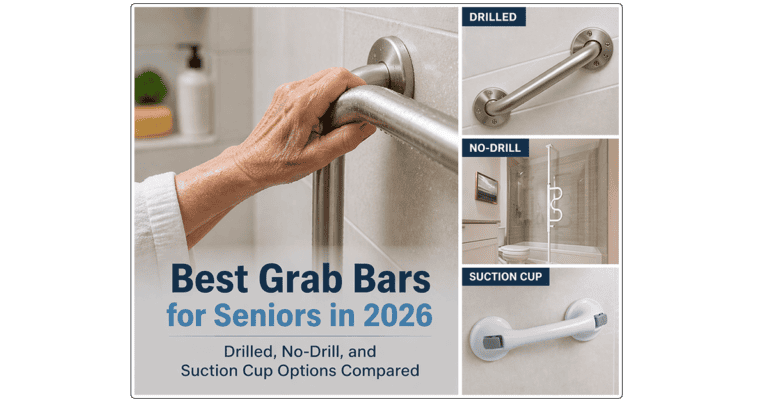
There are three mounting types, and choosing the right one comes down to how much support the person actually needs and whether permanent installation is possible.
Drilled wall-mounted grab bars are the gold standard. They anchor into wall studs or use specialized anchors rated for the load. A quality drilled bar like the Moen Home Care Peened Concealed Screw Grab Bar (Model R8718P, ASIN: B000Y4S52M) supports up to 500 lbs and meets ADA specifications. If the person needs a grab bar to bear their full body weight during a transfer — getting in or out of a shower, for example — this is the only appropriate choice.
Floor-to-ceiling tension poles like the Stander Security Pole & Curve Grab Bar (ASIN: B0026IBRTC) require no drilling and can be moved from room to room. They’re useful for people who need assistance standing up from a toilet, bed, or chair. Weight capacity is typically 300 lbs. They are not ADA compliant and should not be used as a primary shower safety bar — but for stand-assist support throughout the home, they serve a real purpose.
Suction cup grab bars like the Safe-er-Grip Suction Cup Grab Bar (Model S10255, ASIN: B000S8O9ME) are temporary and portable. They attach to smooth, non-porous surfaces with flip-lock tabs. Important: suction cup bars are balance assist aids only — they are explicitly not rated for full body weight, and manufacturers require you to test the suction before every single use. They work well for travel, for light balance assistance, or as a short-term solution while waiting for permanent installation. They are not a substitute for a drilled bar where genuine fall risk exists.
2. Weight capacity
Always choose a bar rated well above the person’s body weight — aim for at least 1.5 times their weight. For most seniors, a 250–300 lb capacity bar is sufficient for balance support. For transfer assistance (where the full body weight may be applied), choose a bar rated at 500 lbs. ADA-compliant drilled bars routinely hit this rating. Suction cup bars do not carry official weight ratings for full body weight — they are balance aids only.
3. Bar diameter and texture
The ADA standard bar diameter is 1.25 to 1.5 inches — this range fits most adult hands comfortably and allows a secure grip without straining arthritic fingers. Thinner bars are harder to grip firmly; wider bars can be difficult to wrap a hand around. Texture matters too: a peened or knurled finish (like the Moen R8718P) provides grip even with wet hands. Smooth chrome bars look attractive but can be slippery when wet — not ideal for a primary safety bar.
4. Bar length and placement
Bar length determines where the hand can comfortably grip through a range of motion. For shower and tub entry, a horizontal bar of 18–24 inches placed 33–36 inches from the floor covers most people’s natural grip zone. For a toilet, an angled bar mounted beside the toilet works better than a purely horizontal one — it gives support both sitting down and standing up. For a step-in shower, consider both a horizontal bar at mid-height and a vertical bar at the entry point for the transition moment.
5. ADA compliance — what it means at home
ADA compliance is a legal requirement for public and commercial spaces, not private homes. However, the ADA specifications exist because they reflect what actually works safely for people with mobility challenges. A bar that meets ADA standards has been tested to support 250 lbs of force in any direction. That’s a meaningful safety benchmark regardless of where you’re installing it. Only permanently drilled bars can be ADA compliant — suction cup and tension pole products cannot meet this standard by design.
6. Finish and aesthetics
For a senior living at home, aesthetics matter more than people give credit for. A bar that looks clinical or institutional is less likely to be used consistently. Moen’s peened stainless finish, for example, coordinates with standard bathroom hardware and doesn’t announce itself as a medical device. If the person will feel better about a bar that looks like it belongs in the bathroom, choose accordingly — the bar that gets used is the safe one.
Features to watch out for
Towel bar installations. Never use a towel bar as a grab bar, and never install a grab bar using towel bar hardware. They are not rated for body weight loads. This is one of the most common and dangerous bathroom safety mistakes.
Suction cups on textured or painted surfaces. Suction cups require smooth, flat, non-porous surfaces — glazed tile is ideal. They will not hold on textured tile, stone, painted drywall, or any surface with grout lines under the cups. If the bathroom surface isn’t smooth glazed tile or acrylic, suction cup bars are not appropriate.
Unrated or unbranded bars. Generic grab bars with no published weight rating or no brand accountability should be approached carefully. The major brands — Moen, Kohler, Delta, Carex — publish tested load ratings and stand behind their products with warranties. For a safety device, that accountability matters.
What to expect at different price points
Budget ($15–$30): Suction cup grab bars fall into this range. Adequate for light balance assistance and travel, with the limitations described above. Not appropriate as a primary safety solution where fall risk is significant.
Mid-range ($50–$120): Drilled wall-mounted bars from reputable brands like Moen, Kohler, and Delta land here. This is the sweet spot for most families — you get a properly rated, ADA-compliant bar with a quality finish and a manufacturer warranty. The Moen R8718P sits comfortably in this range.
Premium ($120–$250+): Floor-to-ceiling tension poles and multi-feature safety systems fall here. The Stander Security Pole is in this range. Also includes designer grab bars, fold-down bars for shower seats, and integrated shower safety systems. Appropriate for more complex needs or when aesthetics are a priority.
Our recommendations by mounting type
For a full comparison of the best grab bars across all three mounting types, see our complete roundup: Best Grab Bars for Seniors in 2026. Here’s a quick summary by category:
| Product | Mounting Type | Best For | Weight Capacity |
|---|---|---|---|
| Moen R8718P | Drilled wall-mount | Primary shower & tub safety | 500 lbs |
| Stander Security Pole | Floor-to-ceiling tension | Stand assist, no-drill homes | 300 lbs |
| Safe-er-Grip S10255 | Suction cup | Balance assist, travel | Balance assist only |
For a deeper look at our top drilled wall-mount pick, see our full Moen Home Care Grab Bar review.
Frequently asked questions
Can I install a grab bar myself, or do I need a professional?
A homeowner with basic DIY skills can install a drilled grab bar if they can locate studs and use a drill. The key is proper anchoring — a bar screwed only into drywall will fail under load. If studs aren’t in the right position, professional installation using toggle bolts rated for the load, or Moen’s SecureMount anchors, is the right call. When in doubt, hire a handyperson — it’s a small cost compared to the consequences of a failed installation.
Are suction cup grab bars safe for seniors?
For light balance assistance — steadying yourself while stepping over a tub edge, for example — suction cup bars can help. But they must be tested before every single use, they require perfectly smooth non-porous surfaces, and they are not rated for full body weight. For anyone at real fall risk, a permanently installed drilled bar is the appropriate choice. Suction cup bars should never be the only safety measure in place.
What is the correct height to install a grab bar?
The ADA guideline for shower and tub grab bars is 33–36 inches from the floor, measured to the center of the bar. This covers most adults’ natural grip height. For toilet assistance, angled bars are typically positioned so the front end is about 6 inches forward of the toilet’s front edge. That said, the ideal height varies by the person’s height and how they move — installing at the height that feels natural to the user is more important than matching a number exactly.
Will a grab bar damage my tile?
A properly installed drilled bar requires drilling through tile, which is permanent. However, the installation should be watertight when done correctly with proper backing, silicone sealant, and the right anchors. A failed or leaking installation is a much bigger problem than the holes themselves. If preserving the tile is a priority and fall risk is low, a tension pole or high-quality suction cup bar may be appropriate — but for genuine safety needs, the permanent installation is worth it.
The bottom line
For most families, the right answer is a permanently installed drilled grab bar from a reputable brand — properly placed, properly anchored, rated for at least 250–500 lbs. That’s the solution that will actually be there when it’s needed. Suction cup bars have their place for travel or light assistance, and tension poles are genuinely useful for stand-assist support throughout the home. But if the goal is preventing a fall in the shower or tub, nothing replaces a properly installed bar.
For specific product recommendations across all three mounting types, with full specs and honest assessments, see our complete roundup: Best Grab Bars for Seniors in 2026. And for a full deep-dive on our top pick, see our Moen Home Care Grab Bar review.
Last reviewed: April 2026